
What Is Product Carbon Footprint (PCF)? A Practical Guide for Manufacturers
Date: 28/10/2026
Can you send us the carbon footprint for this part?
More Malaysian suppliers are hearing this question from customers, often with a spreadsheet attached and a short deadline. For many factory owners it is the first time they are asked for carbon data at product level, and it is not always clear what the customer actually wants.
This guide explains what Product Carbon Footprint (PCF) is, how it differs from other carbon and ESG terms, why buyers are asking for it now, and how a Malaysian manufacturer can prepare a first PCF without overcomplicating it.
In This Article
What Product Carbon Footprint Is
Product Carbon Footprint is the total greenhouse gas (GHG) emissions linked to one product, expressed in kilograms of carbon dioxide equivalent (kg CO₂e) per unit. The unit could be one piece, one kilogram, one metre or one carton, as long as it is clearly defined.
The internationally recognised standard is ISO 14067:2018, which sets out requirements and guidelines for quantifying and reporting a product's carbon footprint. The GHG Protocol Product Standard is another widely used methodology.
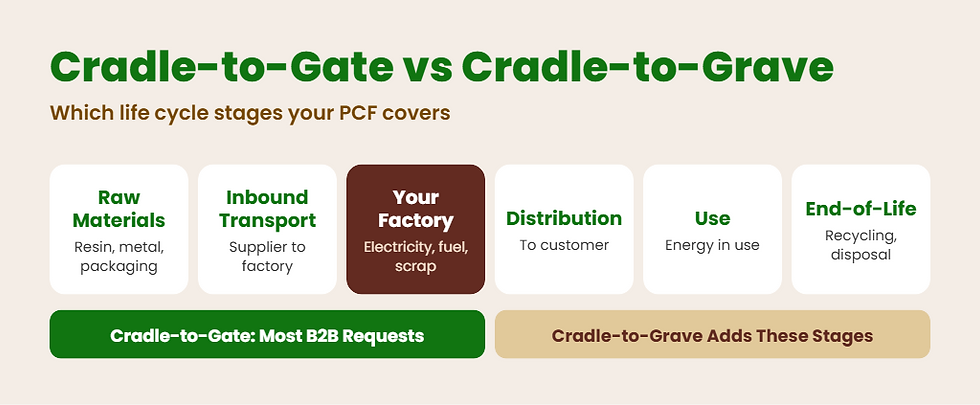
Most supplier requests are for a cradle-to-gate PCF. This covers emissions from raw materials, inbound transport and your own production, up to the point the product leaves your factory gate. A cradle-to-grave PCF goes further to include distribution, use and end-of-life, and is less common for B2B components.
PCF vs Carbon Inventory vs LCA vs ESG Reporting
These terms are often mixed up, but they answer different questions:
Term | What It Covers |
Organisational Carbon Inventory | Total emissions of the whole company over a year (Scope 1, 2 and 3) GHG Protocol Corporate Standard, ISO 14064-1 |
Product Carbon Footprint (PCF) | Emissions of one product, per declared unit ISO 14067, GHG Protocol Product Standard |
Life Cycle Assessment (LCA) | Wider environmental impacts of a product, such as water, resource use and pollution, not only carbon ISO 14040 and ISO 14044 |
ESG Reporting | Company-level disclosure on environmental, social and governance matters, with carbon as one part Frameworks such as IFRS S1 and S2 under the NSRF |
Key Point: A company can have a carbon inventory and still be unable to answer a PCF request, because the customer needs emissions allocated to a specific product, not the factory total.
Why Customers Are Asking for PCF Now
Three developments are pushing carbon data down the supply chain. Not all of them apply to every company, so it is worth checking which ones affect your customers.
1. Customers' Scope 3 Reporting
Under Malaysia's National Sustainability Reporting Framework (NSRF), listed companies adopt the ISSB-based standards in phases, starting with large Main Market issuers in 2025, other Main Market issuers in 2026, and ACE Market issuers and large non-listed companies in 2027.
Scope 3 disclosure, which covers emissions from purchased goods, is being phased in after that. Product-level data from suppliers helps customers replace rough estimates with real figures.
2. EU Carbon Border Adjustment Mechanism (CBAM)
Since 1 January 2026, EU importers of covered goods, such as iron and steel, aluminium, cement, fertilisers, electricity and hydrogen, are in the definitive CBAM period. They must report embedded emissions, and certificate sales for 2026 imports are scheduled to begin in February 2027.
Importers can use default values, but these are set conservatively, so suppliers that provide verified actual data may be preferred.
3. Malaysia's Planned Carbon Tax
The Government has said it is finalising a national carbon tax policy, with iron, steel and energy as the initial focus and the rate to be phased in.
As of June 2026, the rate and start date have not been confirmed.
Key Point: For most SMEs, the immediate driver is not regulation on their own company but a request from a customer who needs the data for their own reporting or export compliance.
What Data You Need for a First PCF
A cradle-to-gate PCF is built on data most factories already have, though it is often scattered across departments:
Data Needed | Where to Find It |
Production output | Production reports or ERP records |
Bill of materials (types and weights per unit) | Engineering or BOM records |
Purchased materials and packaging | Purchase orders and supplier invoices |
Electricity and solar generation | TNB bills and solar meter readings |
Fuel use (diesel, LPG, natural gas) | Fuel purchase records and usage logs |
Scrap, rejects and waste | QC reports, waste and scrap sale records |
Inbound transport for key materials | Delivery and logistics records |
Allocation of shared energy and overheads | Machine hours, production time or output share |
Twelve months of data is the usual starting point, so that seasonal changes in production are reflected.
Five Practical Steps to Start

Step 1: Choose One Product
Start with the product your customer is asking about, or your highest-volume product.
Step 2: Define the Unit and Boundary
Agree with the customer on the declared unit and whether they need cradle-to-gate.
Step 3: Collect Activity Data
Gather the data above for the same period, and note where figures are estimated.
Step 4: Apply Emission Factors
Convert activity data into kg CO₂e using recognised emission factor sources, and record which factors and versions you used.
Step 5: Document and Review
Write down your assumptions, allocation method and data gaps, so the result can be explained, updated or verified later.
Note: If the PCF will be used in a public claim or a formal customer declaration, third-party verification against ISO 14067 may be required. Confirm this with your customer early.
Common Mistakes to Avoid
1. Dividing Factory Totals by Output
Dividing the factory's total emissions by total output without considering product differences.
2. Leaving Out Scrap and Rejects
Leaving out scrap and rejects, which can hide a significant share of material emissions.
3. Mixing Data from Different Periods
Mixing data from different periods, such as last year's electricity with this year's output.
4. Relying Only on Spend-Based Estimates
Using spend-based estimates for everything when actual quantities are available.
5. Making Claims without Evidence
Making marketing claims such as “low-carbon” or “carbon neutral” without a documented and verifiable basis.
More Than a Compliance Exercise
A PCF often shows where emissions are concentrated. For many manufacturers, the hotspots are purchased materials and electricity. These are also major cost items, so the same data can point to opportunities in material yield, scrap reduction and energy efficiency.
The results depend on each factory's processes, so savings should be assessed case by case rather than assumed. What a PCF does give you is a clearer, fact-based answer when a customer asks about your carbon performance.
How Kalyx ESG Academy Can Help
Kalyx ESG Academy helps Malaysian SMEs and manufacturers build practical, in-house capability for PCF and ESG. Our support includes PCF awareness training, internal team capability development, a PCF data collection framework, and calculation and reporting support.
If a customer has asked you for carbon data, or you want your team to be ready before they do, talk to Kalyx ESG Academy about where to start.
Sources:
ISO 14067:2018 Greenhouse Gases: Carbon Footprint of Products, ISO
Product Life Cycle Accounting and Reporting Standard, GHG Protocol
National Sustainability Reporting Framework to Enhance Sustainability Disclosures, Securities Commission Malaysia, 24/09/2024
What You Need to Know as CBAM Simplification Comes into Effect, Reed Smith
National Carbon Tax Policy in Final Phase, The Star, 25/06/2026
This article is for general information only and does not constitute professional or legal advice. Requirements may change; please check the latest official guidance or speak to a qualified adviser for your specific situation.