top of page


Starting a Business in Malaysia
A Practical Guide for New Business Owners
Choosing the right business structure is an important first step towards protecting your interests, meeting legal requirements and building a strong foundation for long-term growth.
Choose the Right Business Structure
Before registering your business, consider your ownership arrangement, level of business risk, expected income, compliance responsibilities and future growth plans. The business structure you choose may affect your personal liability, tax treatment, operating costs, ability to raise funds and long-term business continuity.
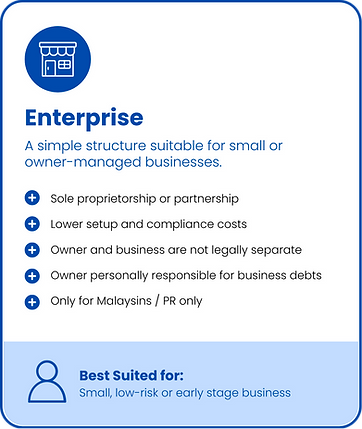

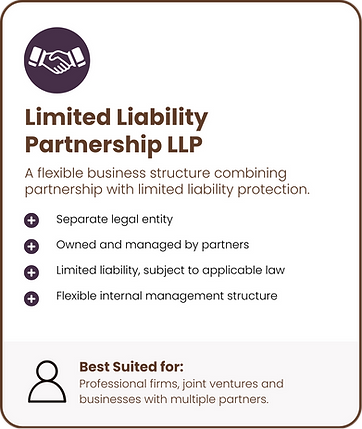


What You Need to Know About Setting Up a LLP in Malaysia: A Guide for Entrepreneurs
Setting up a Limited Liability Partnership (LLP) can be an important decision for entrepreneurs who wish to combine the flexibility of a traditional partnership with the protection of limited liability. This business structure is particularly suitable for professional firms, family businesses, joint ventures and businesses operated by two or more partners. In this guide, you will learn the key requirements for establishing an LLP in Malaysia, including its benefits, registrat


Complete Guide on Registering a Sdn Bhd in Malaysia
Incorporation of Sdn Bhd Setting up a private limited company (Sdn Bhd) is one of the most common methods for entering the Malaysian market. This type of company offers limited liability protection and is treated as a separate legal entity, meaning its debts and obligations are not tied to individual shareholders. The Malaysian government actively encourages business development and provides a relatively streamlined registration process. Basic Requirement & Information Under


What You Need to Know About Setting Up a Sdn Bhd in Malaysia: A Guide for Entrepreneurs
If you plan to conduct business in Malaysia, choosing an appropriate legal structure is crucial. Among the various business entities available, the Sendirian Berhad (Sdn Bhd), or Private Limited Company, stands out as the most popular choice for formal businesses, mid-sized enterprises, and foreign companies. This article will provide a comprehensive overview of Sdn Bhd companies, covering their key characteristics, advantages, disadvantages, eligibility criteria, and the ste
Frequently Asked Question
Yes. A company may generally change its company secretary at any time. However, you should first check the terms and conditions of your existing company secretarial engagement, including any notice period, termination requirements or outstanding fees.
No, The process is easy and Kalyx team can guide you through the process, prepare the required documents and coordinate the handover of statutory records from your existing company secretary.
The timeline depends on how quickly the required documents are signed, how soon the existing company secretary completes the handover of the company records, and the processing of the relevant changes with SSM.
Generally, we will need your company name, registration number and relevant company information.You may also provide us with the contact details of your existing company secretary, so our team can coordinate the handover of the company’s statutory records and documents.
Under Section 236 of the Companies Act 2016, a company must appoint a company secretary within 30 days from the date of incorporation. Every company must have at least one company secretary.If the company’s only secretary resigns, a replacement secretary should also be appointed within 30 days.Failure to comply with the Companies Act 2016 may expose the company and/or its officers to regulatory action, penalties or compounds, depending on the nature of the non-compliance.
A Company Secretary is not your company’s day-to-day administrator.
such as invoicing, customer follow-up, scheduling, document preparation or general office work
Their role is mainly to manage the company’s corporate and statutory complianceThe key responsibilities generally include:Maintaining the company’s statutory registers and recordsPreparing and submitting the Annual ReturnMaintaining Beneficial Ownership informationPreparing board and shareholder resolutionsUpdating changes in directors, shareholders, shares and company particularsAssisting with share allotments and share transfersKeeping track of important statutory deadlinesLodging relevant documents and changes with SSMAdvising directors on basic corporate compliance requirementsMaintaining the company’s registered office recordsCoordinating the lodgement of financial statements with SSM, where applicable
The company secretarial fee is an ongoing retainer, not a fee charged only when a transaction happens.Even if there are no changes to your directors, shareholders or share capital, the Company Secretary still needs to maintain your company’s statutory records, registered office, beneficial ownership information, compliance deadlines and annual filing requirements.The retainer fee therefore covers the ongoing responsibility, availability and compliance support provided throughout the year.
Yes. Kalyx also provides accounting, payroll, tax, business advisory, transfer pricing and other professional services, subject to the relevant engagement.
No. Preparing legal agreements is not within the scope of company secretarial services.Agreements such as a Shareholders’ Agreement, Sale & Purchase Agreement, Partnership Agreement or other commercial contracts should be prepared or reviewed by a qualified lawyer.Where applicable, Kalyx can assist with the related company secretarial documents and corporate resolutions required after the agreement has been finalised.
Generally, the incorporation process can be completed within 3–5 working days after all required information and documents are provided, subject to SSM processing and approval.
No. The standard incorporation process can be handled fully online through our team.
Yes. A Sdn Bhd allows the same individual to act as both the shareholder and director, provided the person meets the applicable legal requirements to act as a director.
Yes, in many cases you can, if the business is genuinely operated from your home.However, you should check whether there are any restrictions from the local council, landlord, building management or relevant licensing authority.Tax implication:Household expenses such as electricity and water are usually difficult to separate between personal and business use. Therefore, the company should not automatically claim the full amount as a business expense.If there is no clear and reasonable basis to determine the business portion, it is generally safer not to claim the personal household expenses through the company.If the company pays rent to you for using your home, the rental received may also need to be declared as your personal rental income.
A Sdn Bhd may generally be incorporated with paid-up capital as low as RM1.However, a higher paid-up capital may be required for:Business licensesWork permits or employment passesGovernment projectsBanking facilitiesRegulated industriesBusiness operational requirements
Yes. Foreigners can own up to 100% of a Malaysian Sdn Bhd for many types of business activities. However, the company must have at least one LOCAL DirectorCertain industries may require local ownership, specific licences or additional approvals.
For a small active Sdn Bhd, the estimated annual maintenance cost is generally around RM8,000–RM12,000, depending on the size and complexity of the business.This may cover company secretarial, accounting, tax compliance and audit services, where applicable.The actual cost depends on factors such as transaction volume, number of employees, SST or e-Invoice requirements, audit requirements and the complexity of the company's operations.
Yes. Your incorporation package can include company secretarial setup and ongoing secretarial support.
Depending on the business, the next steps may include:Appoint a company secretary within 30 days from date of incorporation (Kalyx will be appointed as your company secretary as part of the incorporation arrangement)
Open a corporate bank account
Apply Business License business licenses and permits
Apply for utility services
water (PBA), telephone and internet (TM), electricity (TNB)
Register as an Employer When Hiring EmployeesEPF / KWSP employer registrationSOCSO / PERKESO registrationEIS registrationPCB / Monthly Tax Deduction setupEmployee payroll recordsSubmit CP22 Forms (Notification of New Employee)Prepare Employments Contract for Stamping
Arrange Tax Matters
The company should ensure that its income tax registration and tax profile are properly set up.Corporate income tax registration (C file & E file)Appointment of a tax agentSubmission of CP204 Tax Estimation Form
Set Up Your Accounting Records
Once the company starts receiving or spending money, proper accounting records should be maintained.
This includes recording:Sales and incomePurchasesBusiness expensesBank transactions / statementsDirector payments and reimbursementsLoansAssetsInventory, where applicable
bottom of page